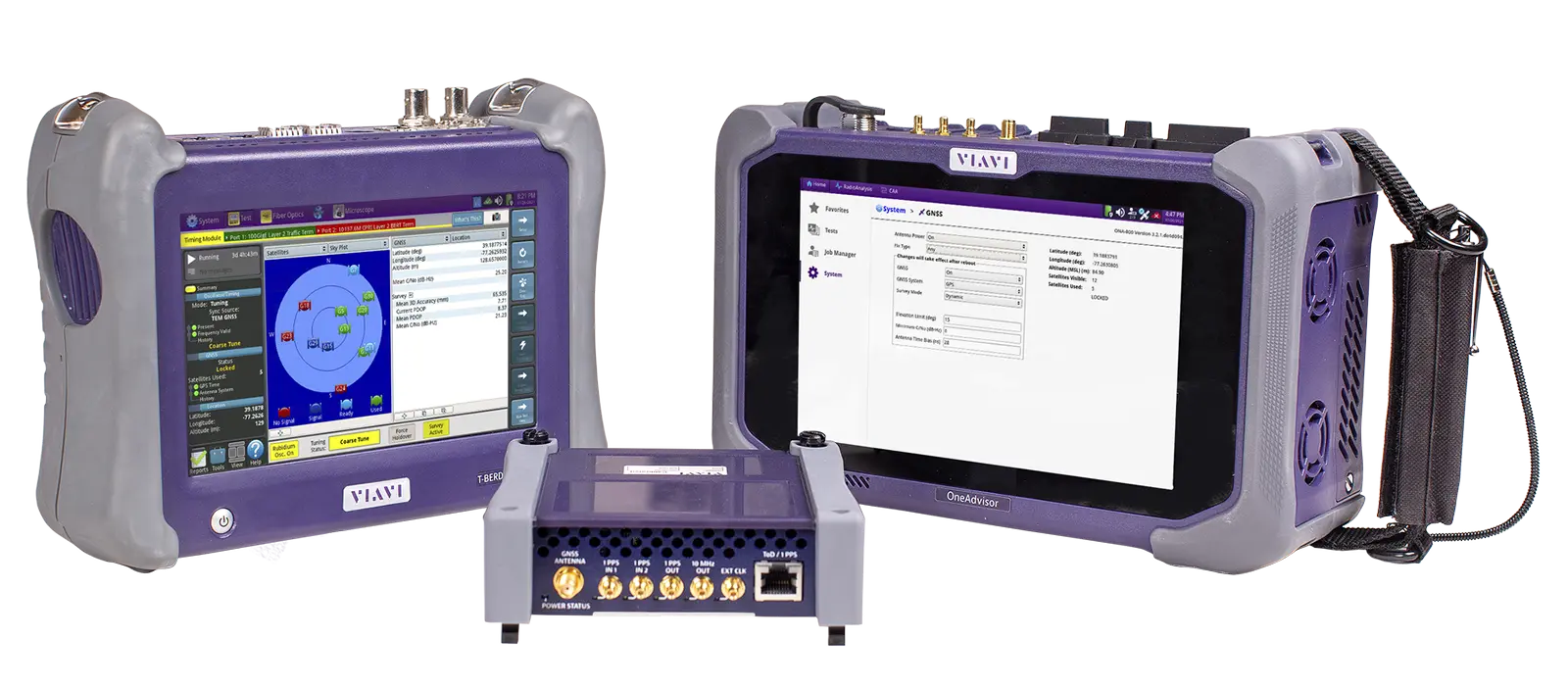
VIAVI Timing Expansion Module V2 (TEM V2) for T-BERD/MTS-5800 and OneAdvisor 800
Field timing and synchronization module with multi-band GNSS receiver and rubidium oscillator for T-BERD/MTS-5800 and OneAdvisor 800.
- Weight
- 0.45 kg (1.0 lb)
- Dimensions
- 12.9 x 13.5 x 4.7 cm; (5.9 x 5.4 x 1.8 in)
- Time error
- <= 176 ns over 8 hours
- Average frequency stability
- <= 6E-12 over an 8-hour period
Overview
The VIAVI Timing Expansion Module Version 2 (TEM V2) is a field timing and synchronization reference. It is used with the T-BERD/MTS-5800 or OneAdvisor 800 test platforms. With it, network operators can verify the precise synchronization that Radio Access Networks need as ITU-T timing accuracy targets become stricter.
The module has a multi-band GNSS antenna input and a rubidium-based miniature atomic clock (MAC). This keeps measurements accurate to the nanosecond when no satellite signal is present and the module is running in holdover.
The TEM V2 attaches to the host test set, so technicians do not need to carry a second instrument for synchronization testing. It supports IEEE 1588v2 (PTP) time error and packet delay variation measurements, Ethernet and IP one-way delay, GNSS antenna qualification, 1 PPS wander analysis, and T1/E1 jitter and wander measurements.
Key Features
- Multi-channel, multi-band GNSS receiver for fast and accurate satellite acquisition
- Confirms frequency, phase, and time synchronization in the field using ITU G.8265.1, G.8275.1 and G.8275.2 profiles
- Verifies Ethernet and IP one-way delay
- Nanosecond-accurate one-way delay 1/10 GE measurements
- Proves out GNSS antenna installations, including individual satellite signal strength and overall Dilution of Precision
- Concurrent multiple GNSS constellations including GPS, GLONASS, Galileo, BeiDou, and SBAS
- Supports multiple 1 PPS and 10 MHz inputs and disciplined outputs concurrently
- BITS/SETS clock inputs
- Standard RJ-45 V.11 interface per G.703 Amendment 1 supporting 1 PPS and Time of Day inputs
- 1588v2 (PTP) measurements including nanosecond-accurate PDV and time measurements
- PTP grand master (PRTC) emulation
- Wander analysis per ITU G.8262.1, G.8273.1, and G.8273.2
- GNSS 1PPS pulse accuracy to +/-5 ns (1-sigma)
- Rubidium oscillator for holdover operation
Specifications
| Weight | 0.45 kg (1.0 lb) |
|---|---|
| Dimensions | 12.9 x 13.5 x 4.7 cm; (5.9 x 5.4 x 1.8 in) |
| Time error |
<= 176 ns over 8 hours
At room temperature with no vibration (in Holdover)
|
| Average frequency stability |
<= 6E-12 over an 8-hour period
In Holdover; stability is based on a constant room temperature and stable magnetic environment with no vibration
|
| Inputs | Two (2) |
| Output | One (1) — disciplined |
| Time accuracy compared to UTC | ± 5ns 1-sigma |
| Connector | SMA |
|---|---|
| Power | 0, 3.3, and 5V |
| Connector | RJ-45 |
|---|---|
| Input | 1 PPS and Time of Day (ToD) over V.11 serial interface per G.703 |
| Output | 1 PPS per G.703 with adjustable voltages |
| Connector | SMB |
|---|---|
| Inputs | Two (2) |
| Output | One (1) — disciplined |
| Connector | SMB |
|---|---|
| Input | BITS/SETS, 2 MHz, 10 MHz |
| Connector | SMB |
|---|---|
| Input | One (1) |
| Output | One (1) — disciplined |
| Constellations |
GPS, GLONASS, Galileo, BeiDou, and SBAS; sky plot
Web page lists GPS, GLONASS, BeiDou, SBAS, and QZSS; datasheet value shown
|
|---|---|
| Channels | 184 channels with per channel signal strength |
| Time formats | UTC, GPS, Galileo, BeiDou, Glonass |
| Location information | Fixed (configurable), dynamic, survey |
| Sync source | GNSS, 1 PPS, 10 Mhz, BITS/SETS |
|---|---|
| Type | Atomic clock with rubidium oscillator |
Specifications are taken from the manufacturer's documentation. See the datasheet for complete and current values.
Applications
- PTP time error measurement for Class C PTP Boundary Clocks
- One-way delay and network asymmetry measurement
- PTP PDV measurement on non-PTP-aware networks
- GNSS antenna installation qualification
- 1 PPS output accuracy troubleshooting
- T1 and E1 jitter and wander measurement
- PTP frequency accuracy using Floor Packet Percentile (FPP) analysis
- RAN synchronization verification
- Cell tower turn-up and maintenance
Documents & Resources
Related Products
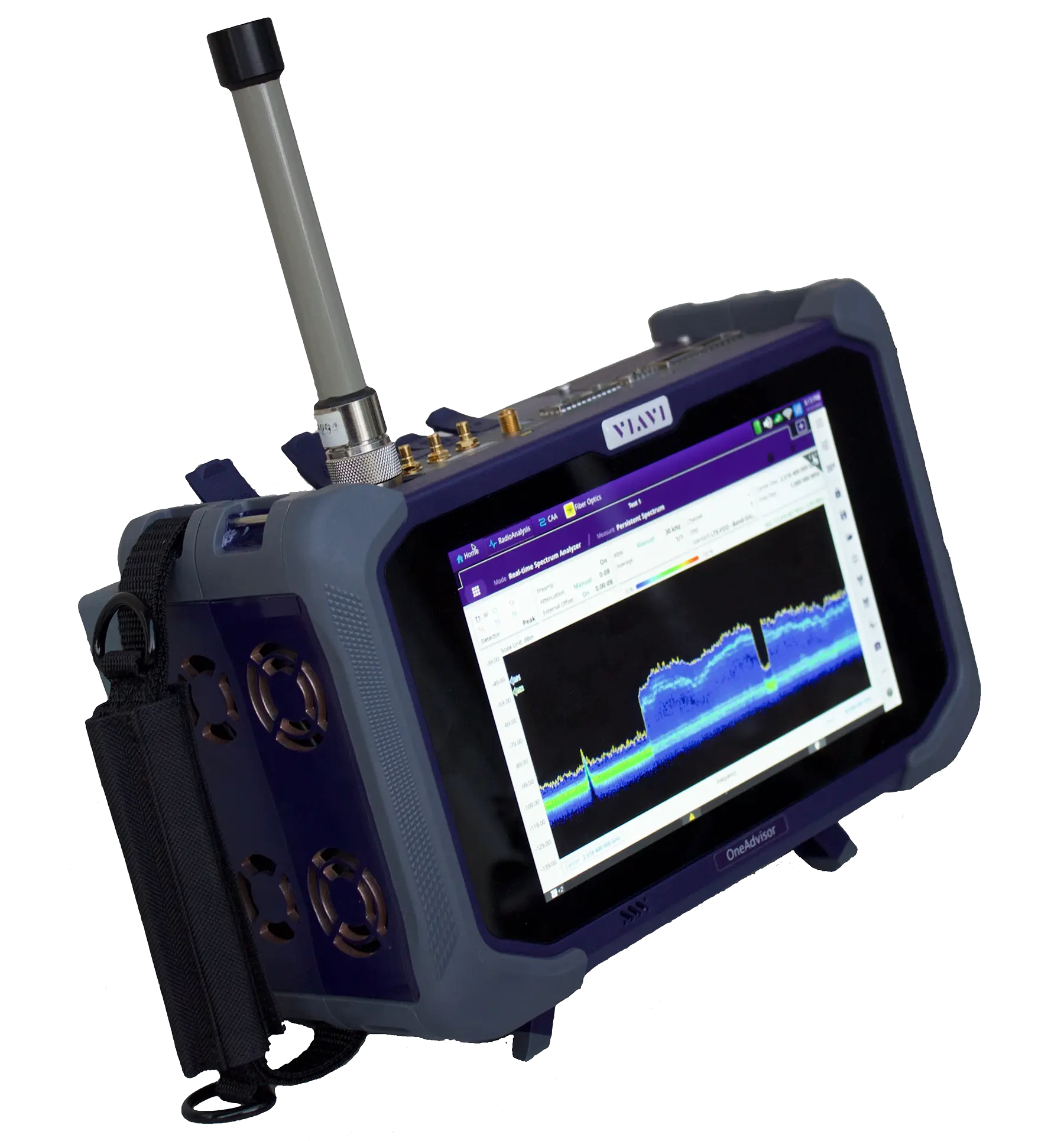
Modular field test platform combining RF spectrum and signal analysis, cable and antenna, fiber and Ethernet transport testing in one portable unit.
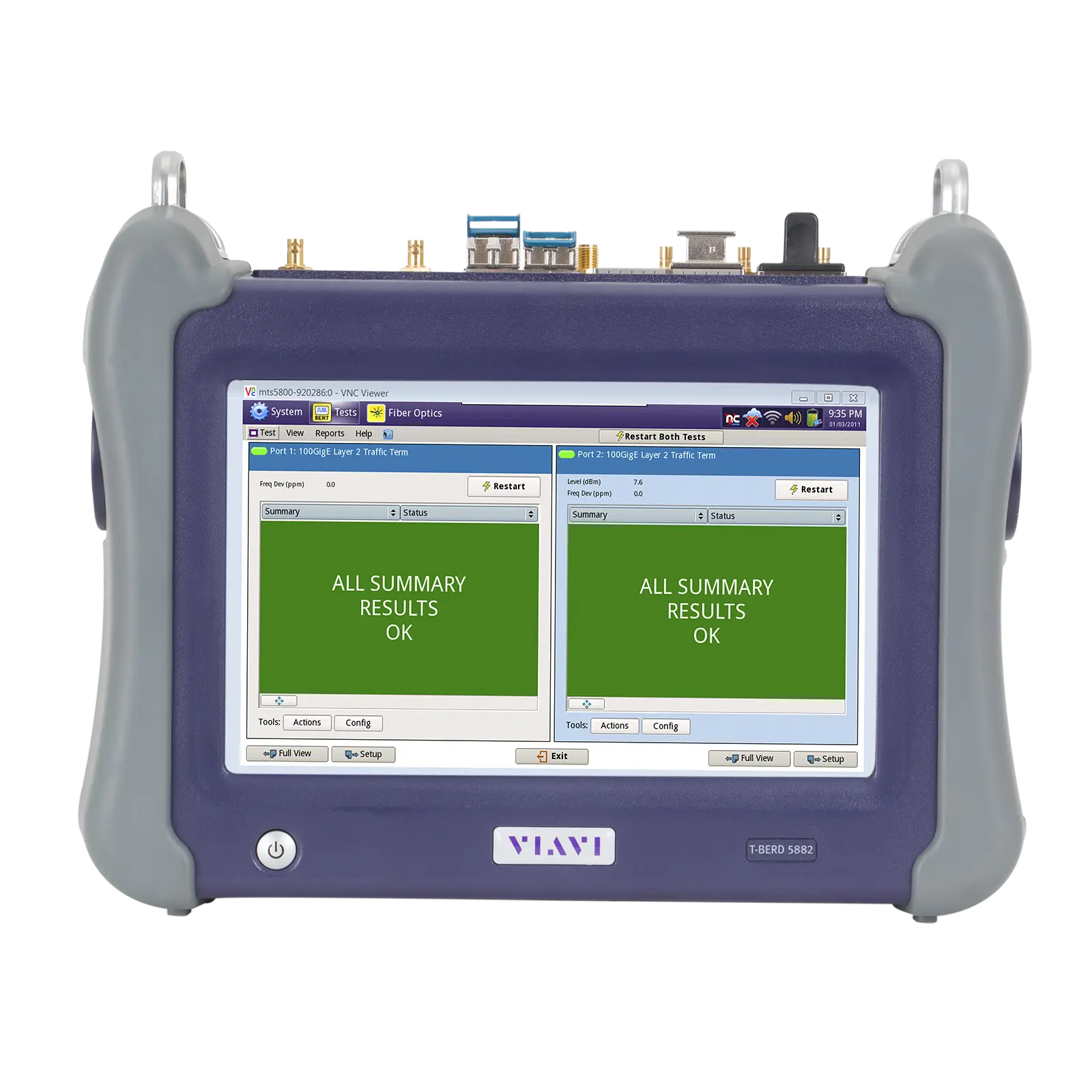
Handheld dual-10G network tester for fiber characterization, service activation, troubleshooting and maintenance of Ethernet, OTN, SONET/SDH and TDM networks.