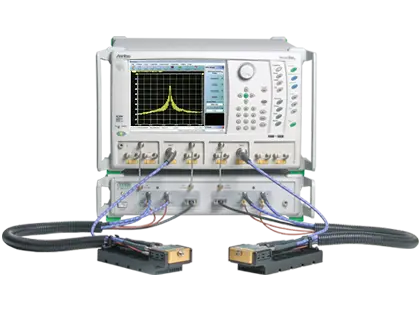
VectorStar ME7838EX 2-Port Broadband Vector Network Analyzer System, 70 kHz to 110 GHz
VectorStar 2-port broadband VNA system with single-sweep coverage from 70 kHz to 110 GHz at a 1 mm coaxial test port.
- Frequency range
- 70 kHz to 110 GHz
- Operational frequency range
- 40 kHz to 110 GHz
- VNA
- MS4647B VectorStar VNA, 70 kHz to 70 GHz with Option 7, Option 70, and Option 86/87/88/89
- Test set
- 3739C Broadband Test Set and interface cables
Overview
The Anritsu VectorStar ME7838EX is a 2-port broadband vector network analyzer system that covers 70 kHz to 110 GHz in a single sweep from a 1 mm coaxial test port. The system can operate from 40 kHz to 110 GHz. It is part of the VectorStar ME7838 broadband series.
The system is made up of an MS4647B VectorStar VNA (70 kHz to 70 GHz, with Option 7, Option 70 and Option 86/87/88/89), a 3739C broadband test set with interface cables, and two 3743EX millimeter-wave modules. Below 54 GHz the base VNA controls port power. Above 54 GHz the 3743EX module controls it, using real-time electronic power leveling.
The 3743EX modules use Anritsu Nonlinear Transmission Line (NLTL) technology. They are small and light, so they can be placed close to the device under test on a wafer probe station. Thin-film multipliers, receivers and couplers sit at the test port, which gives good raw directivity and stable calibrations. The manufacturer quotes calibration and measurement stability of 0.1 dB vs 0.6 dB over 24 hours.
Waveguide and upgrade paths
The ME7838EX can also be set up as a millimeter waveguide system covering 50 GHz to 1.1 THz in waveguide bands. This can extend the broadband system or replace it. E and W band operation is possible in three ways: the 3743EX module with waveguide adapters, the 3744E-EE or 3744E-EW modules, or external E and W band modules. The ME7838EX can be upgraded to 145 GHz and 220 GHz. With the 3744x-Rx receiver it supports noise figure measurements, including differential noise figure.
Key Features
- Single sweep coverage from 70 kHz to 110 GHz, operational from 40 kHz to 110 GHz
- Can be upgraded to 145 GHz and to 220 GHz
- Can be configured with banded millimeter-wave modules up to 1.1 THz
- Calibration and measurement stability of 0.1 dB vs 0.6 dB over 24 hrs
- Compact, lightweight mmWave modules: 0.6 vs 7.6 lb and 1/50 the volume
- Thin film multipliers, receivers and couplers at the test port for high raw directivity
- Real time electronic mmWave power leveling, with no software correction tables
- Compatible with all major probe stations
- Kelvin bias tees for sense and force capabilities positioned close to the DUT
- Supports the 3744x-Rx receiver for noise figure measurements, including differential noise figure
- Spectrum analyzer option (Option 49) for harmonics, spurs and distortion measurements
- 4-port version available as ME7838E4X
Specifications
| Frequency range |
70 kHz to 110 GHz
Single sweep; the web page feature text says 'ME7838EX to 125' but the datasheet and the page configuration table give 110 GHz
|
|---|---|
| Operational frequency range | 40 kHz to 110 GHz |
| VNA | MS4647B VectorStar VNA, 70 kHz to 70 GHz with Option 7, Option 70, and Option 86/87/88/89 |
| Test set | 3739C Broadband Test Set and interface cables |
| mmWave modules | 3743EX Millimeter-Wave Modules, 2 each |
| Test port |
1 mm coax output
W1 test ports
|
| Millimeter waveguide configuration |
50 GHz to 1.1 THz
Waveguide bands; can extend the broadband system or operate only as a waveguide system
|
| Port RF out (base VNA) |
70 kHz to 54 GHz
Port power is controlled by the base VNA below 54 GHz and by the 3743EX module above 54 GHz
|
| 70 to 300 kHz |
95 (110)
Typical values in parentheses; excludes localized spurious responses and crosstalk
|
|---|---|
| > 0.3 to 2 MHz |
107 (120)
Typical in parentheses
|
| > 2 to 10 MHz |
130 (140)
Typical in parentheses
|
| > 0.01 to < 2.5 GHz |
119 (130)
Typical in parentheses
|
| 2.5 to 10 GHz |
117 (125)
Typical in parentheses
|
| > 10 to 24 GHz |
109 (120)
Typical in parentheses
|
| > 24 to 40 GHz |
107 (115)
Typical in parentheses
|
| > 40 to 54 GHz |
107 (115)
Typical in parentheses
|
| > 54 to 60 GHz |
107 (116)
Typical in parentheses
|
| > 60 to 65 GHz |
107 (116)
Typical in parentheses
|
| > 65 to 80 GHz |
106 (116)
Typical in parentheses
|
| > 80 to 90 GHz |
104 (110)
Typical in parentheses
|
| > 90 to 100 GHz |
104 (110)
Typical in parentheses
|
| > 100 to 110 GHz |
104 (110)
Typical in parentheses
|
| 70 to 300 kHz |
10 (13)
Typical in parentheses; using 806-206-R 1.85 mm test port cables
|
|---|---|
| > 2 to 10 MHz |
12 (15)
Typical in parentheses
|
| > 0.01 to < 2.5 GHz |
10 (13)
Typical in parentheses
|
| 2.5 to 10 GHz |
4 (8)
Typical in parentheses
|
| > 10 to 24 GHz |
-1 (3)
Typical in parentheses
|
| > 24 to 40 GHz |
-2 (3)
Typical in parentheses
|
| > 40 to 54 GHz |
-7 (-2)
Typical in parentheses
|
| > 54 to 60 GHz |
-2 (1)
Typical in parentheses
|
| > 65 to 70 GHz |
-6 (-1)
Typical in parentheses
|
| > 80 to 90 GHz |
-6.5 (-2)
Typical in parentheses
|
| > 90 to 100 GHz |
-2.5 (2)
Typical in parentheses
|
| > 100 to 110 GHz |
-6.5 (-3)
Typical in parentheses
|
| 70 kHz to 10 MHz |
10 to -25
12 to -25 from > 2 to 10 MHz
|
|---|---|
| > 0.01 to < 2.5 GHz | 10 to -25 |
| > 24 to 40 GHz | -2 to -30 |
| > 40 to 54 GHz | -7 to -30 |
| > 54 to 60 GHz | -2 to -55 |
| > 100 to 110 GHz | -6.5 to -55 |
|
70 to 300 kHz, Option 61 or 62
Option 61, Option 62
|
7 to -85 |
| Accuracy, 70 kHz to 10 MHz |
(± 0.3)
Typical; defined at -10 dBm or max rated power, whichever is lower
|
|---|---|
| Accuracy, > 24 to 54 GHz |
(± 0.9)
Typical
|
| Accuracy, > 90 to 110 GHz |
(± 2.3)
Typical
|
| Resolution | 0.01 |
| Linearity, > 100 to 110 GHz |
(± 1)
Typical; incremental error between the accuracy test power level and 5 dB below
|
| 70 to 300 kHz |
(6)
Typical; without Option 61 or 62; 0.2 dB compression point
|
|---|---|
| > 0.01 to < 2.5 GHz |
(11)
Typical; without Option 61 or 62
|
| > 24 to 110 GHz |
(10)
Typical; per band from > 24 to 110 GHz
|
| 70 to 300 kHz |
-85 (-97)
Typical in parentheses
|
|---|---|
| > 2 to 10 MHz |
-118 (-125)
Typical in parentheses
|
| > 0.01 to < 2.5 GHz |
-109 (-117)
Typical in parentheses
|
| > 40 to 54 GHz |
-114 (-117)
Typical in parentheses
|
| > 70 to 80 GHz |
-110.5 (-117)
Typical in parentheses
|
| > 100 to 110 GHz |
-110.5 (-113)
Typical in parentheses
|
| > 0.01 to < 2.5 GHz |
0.0045 (0.0017) dB RMS magnitude, 0.03 (0.007) deg. RMS phase
1 kHz IF bandwidth; typical in parentheses
|
|---|---|
| > 80 to 110 GHz |
0.006 (0.0025) dB RMS magnitude, 0.105 (0.05) deg. RMS phase
1 kHz IF bandwidth; typical in parentheses
|
| 70 kHz to 10 MHz |
Directivity 40 (46), Source Match 40 (46), Load Match 38 (44), Reflection Tracking ± 0.10 (± 0.05), Transmission Tracking ± 0.10 (± 0.05)
dB; typical in parentheses
|
|---|---|
| 2.5 to 20 GHz |
Directivity 40 (44), Source Match 40 (46), Load Match 38 (44), Reflection Tracking ± 0.05 (± 0.03), Transmission Tracking ± 0.05 (± 0.03)
dB; typical in parentheses
|
| > 40 to 67 GHz |
Directivity 30 (37), Source Match 36 (42), Load Match 27 (35), Reflection Tracking ± 0.05 (± 0.03), Transmission Tracking ± 0.07 (± 0.05)
dB; typical in parentheses
|
| > 90 to 110 GHz |
Directivity 30 (36), Source Match 34 (40), Load Match 28 (34), Reflection Tracking ± 0.07 (± 0.05), Transmission Tracking ± 0.07 (± 0.05)
dB; typical in parentheses
|
| 70 kHz to 10 MHz |
Directivity 43 (50), Source Match 43 (50), Load Match 40 (43)
dB; typical in parentheses
|
|---|---|
| > 20 to 67 GHz |
Directivity 38 (44), Source Match 40 (44), Load Match 36 (42)
dB; typical in parentheses
|
| > 90 to 110 GHz |
Directivity 34 (38), Source Match 40 (43), Load Match 32 (36)
dB; typical in parentheses
|
| > 54 to 80 GHz |
Directivity (10), Port Match (10)
dB; typical
|
|---|---|
| > 80 to 110 GHz |
Directivity (5), Port Match (7)
dB; typical
|
| Magnitude stability, > 80 to 110 GHz |
(< 0.015)
Typical
|
|---|---|
| Phase stability, > 80 to 110 GHz |
(< 0.15)
Typical
|
| Resolution | 1 Hz |
|---|---|
| Accuracy |
± 5 x 10⁻⁷ Hz/Hz
At time of calibration
|
| Temperature stability | < 5 x 10⁻⁹/°C over 0 °C to 50 °C temperature |
| Aging | < 1 x 10⁻⁹/day aging, instrument on |
| 1-port cal, 401 points, 10 kHz IFBW |
(265)
Typical; full band 70 kHz to 110 GHz, display ON, ALC ON
|
|---|---|
| 2-port cal, 401 points, 10 kHz IFBW |
(530)
Typical; full band 70 kHz to 110 GHz, display ON, ALC ON
|
| Warm-up time | 90 minutes |
|---|---|
| Recommended calibration cycle | 12 months |
Specifications are taken from the manufacturer's documentation. See the datasheet for complete and current values.
Applications
- On-wafer device characterization
- Millimeter-wave component measurements
- Device modeling
- Noise figure measurements
- Differential noise figure measurements
- Spectrum analysis of harmonics, spurious and distortion products
- Pulsed measurements
- Intermodulation distortion measurements
- Material measurements
- Signal integrity measurements
Included
- MS4647B VectorStar VNA, 70 kHz to 70 GHz with Option 7, Option 70, and Option 86/87/88/89
- 3739C Broadband Test Set and interface cables
- 3743EX Millimeter-Wave Modules, 2 each
Options & Accessories
| Option | Description |
|---|---|
| MS4640B-002 | Time Domain |
| MS4640B-021 | Universal Fixture Extraction |
| MS464xB-031 | Dual Source Architecture |
| MS464xB-032 | Internal RF Combiner |
| MS4640B-041 | Noise Figure |
| MS4640B-043 | DifferentialView |
| MS4640B-044 | IMDView |
| MS4640B-046 | Fast CW |
| MS4640B-047 | Eye Diagram |
| MS4640B-048 | Differential Noise Figure |
| MS4640B-049 | Spectrum Analysis — SPA options for all broadband and banded solutions |
| MS464xB-051 | External VNA Direct Access Loops |
| MS464xB-061 | Active Measurement Suite, with 2 Attenuators |
| MS464xB-062 | Active Measurement Suite, with 4 Attenuators |
| SC8215 | Kelvin Bias Tee — V-connectorized bias tee usable with the mmWave modules in the ME7838EX for system frequencies of 70 kHz to 110 GHz; Max Voltage: 16 VDC, Max Current: 100 mA |
| SC7287 | Kelvin Bias Tee — V-connectorized bias tee usable with the mmWave modules in the ME7838EX |
| 3744E-EE | 56 to 95 GHz WR-12 Waveguide Module |
| 3744E-EW | 65 to 110 GHz WR-10 Waveguide Module |