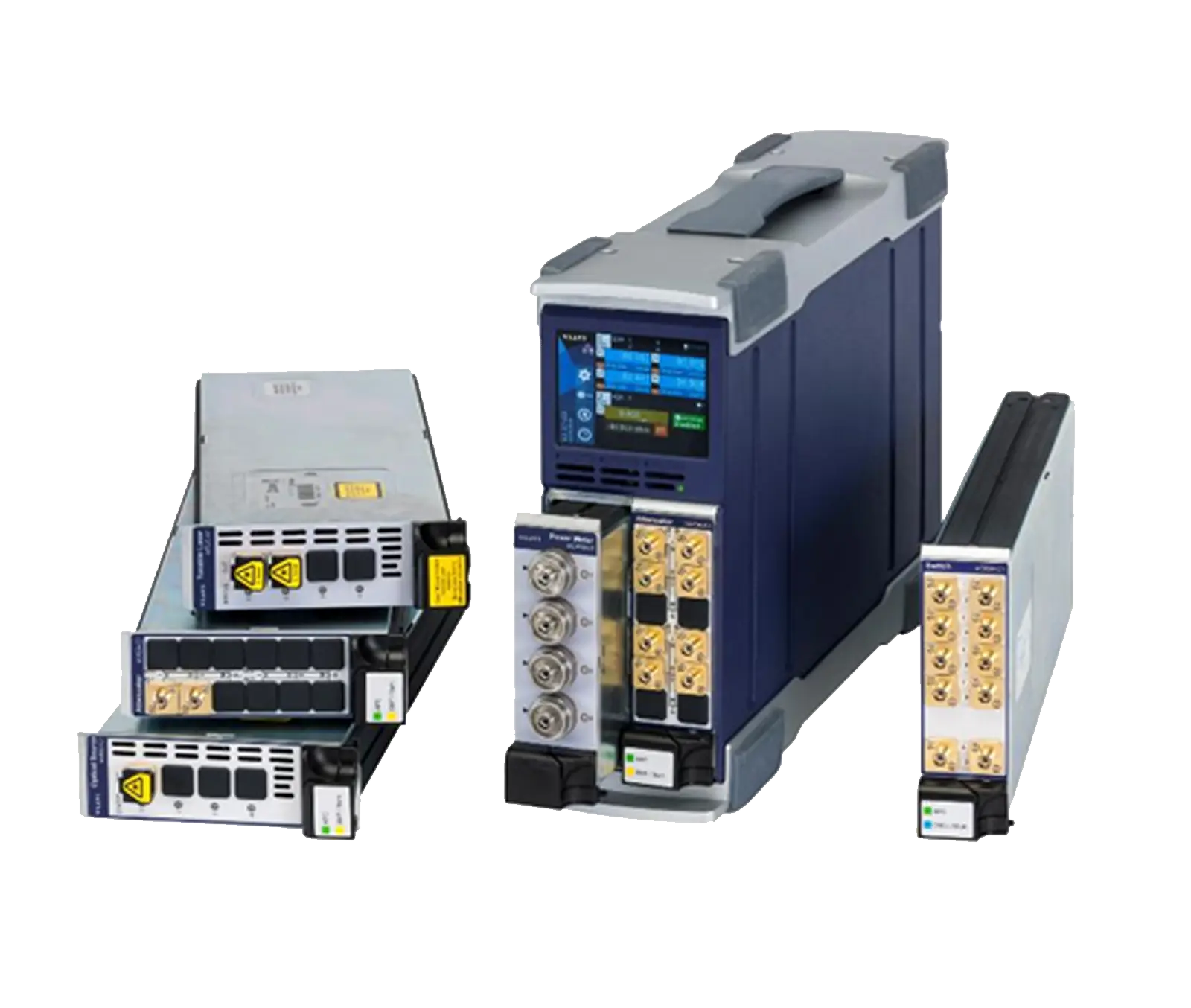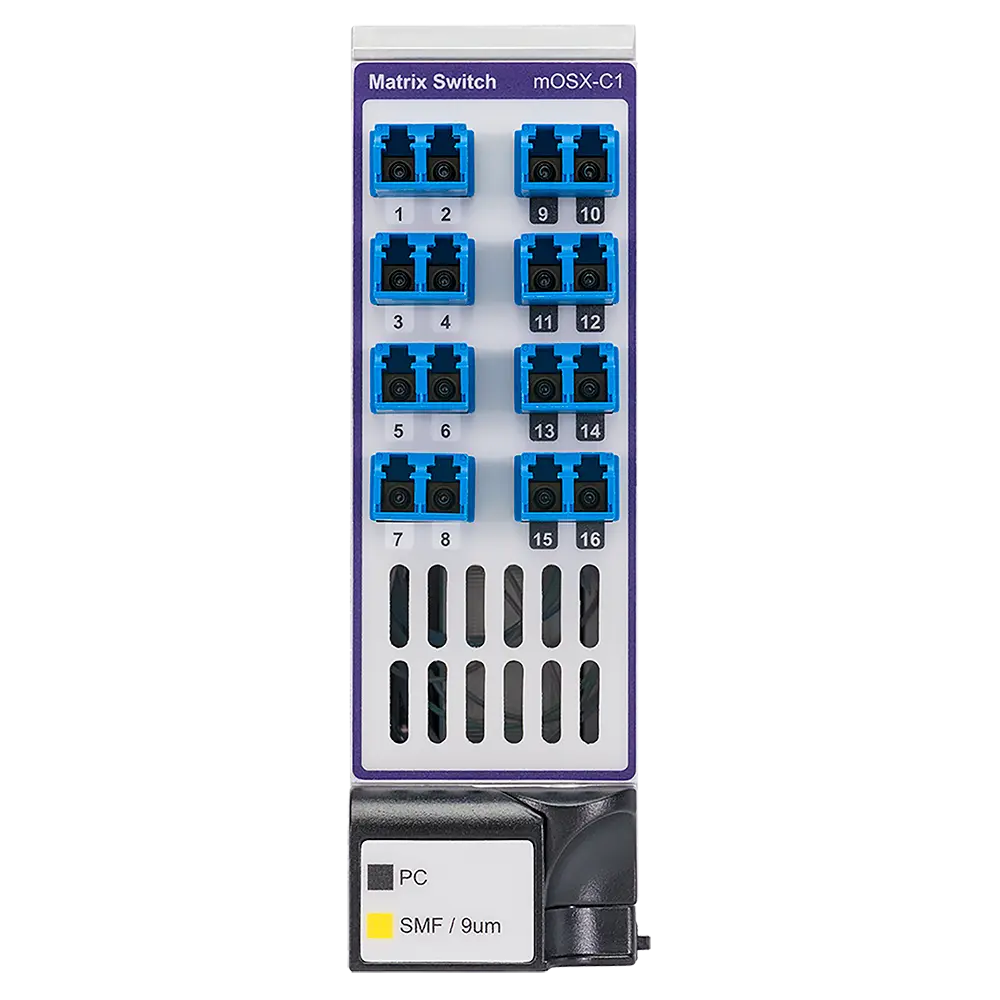
VIAVI MAP mOSX-C1 MOSX-C1132XCCB0-M100-MLC 32-Port LC/PC Optical Matrix Switch Module
32-port common connection single-mode optical matrix switch module for the VIAVI MAP Series with LC/PC bulkheads in a dual-slot format.
- Number of ports
- 32 Ports
- Connector type
- LC/PC bulkhead
- Slot width
- Dual Width
- Chassis compatibility
- All current MAP-300 and MAP-200 chassis
Overview
The MOSX-C1132XCCB0-M100-MLC is the 32-port, LC/PC bulkhead version of the VIAVI MAP Series mOSX-C1 cross connect optical switch. It is a dual-slot module for MAP-300 and MAP-200 chassis and belongs to the VIAVI test automation switch portfolio, where it serves as a low-loss test path manager. Routing several test paths across the switch fabric allows test processes to run in parallel.
Switch fabric
The mOSX is a non-blocking, bidirectional matrix switch. Any port can connect to any other port, so a single module can be set up in symmetric MxM layouts (for example 8x8) or asymmetric ones (for example 4x12), and the layout can be changed whenever needed. Ports can serve as inputs or outputs. All connections can be pre-configured without light present, and each one stays blocked until it is activated. Making or breaking one connection does not affect any other connection. As a software option, the switch can be held to a specific MxN topology so that only connections following that structure are allowed.
Switching principle
The switching engine uses compact piezoelectric actuators to align the signal path through expanded-beam optics. A capacitive sensor matrix measures the position of the collimating lens to keep the alignment stable and repeatable. Connections hold even when no light is present. Reflective optics fold the switch engine so that each fiber can connect to every other fiber.
Control and integration
The module can be controlled through a SCPI remote interface or the MAP Series graphical user interface. Ports can be given logical names, and connections between ports can be disabled or re-enabled. The mOSX is part of the LightDirect switching module family. It can be combined with MAP-Series mOSW modules to build larger switching systems.
Key Features
- Non-blocking, bidirectional matrix switch
- Any port to any port connection fabric
- Symmetric and asymmetric topologies configurable in software
- Wide wavelength range, 1250 to 1675 nm
- 1.0 dB typical insertion loss
- 25ms switching speed
- Flexible SCPI remote interface or MAP Series Graphical User Interface (GUI)
- Connections between ports can be disabled or re-enabled
- Connections can be pre-configured without light present
- Logical port naming in the GUI
- 32 ports with LC/PC bulkhead connectors
- Compatible with all current MAP-300 and MAP-200 chassis
Specifications
| Number of ports | 32 Ports |
|---|---|
| Connector type | LC/PC bulkhead |
| Slot width | Dual Width |
| Chassis compatibility | All current MAP-300 and MAP-200 chassis |
| Matrix Size | 16 or 32 ports |
|---|---|
| Connection Type | Any port to any port |
| Operating Wavelength Range |
1260 nm to 1675 nm
Web page and datasheet feature list state 1250 to 1675 nm; datasheet specification table states 1260 nm
|
| Insertion Loss (IL), Active Connection Maximum |
≤ 1.5 dB
Including one pair of connectors; tested at 1550 nm. 1.0 dB typical per functional description
|
| Insertion Loss (IL), Open Port | > 55 dB |
| Insertion Loss (IL), Inactive Connection | > 55 dB |
| Return Loss (RL) |
> 50 dB
Tested with APC connectors at 1550 nm
|
| Polarization Dependent Loss (PDL) |
< 0.1 dB
For wavelength range of 1530 nm – 1675 nm. Tested at 1550 nm
|
| Repeatability (maximum) |
± 0.05 dB
Measured between two consecutive readings over 100 cycles
|
| IL stability |
± 0.05 dB
Any channel drift relative to reference channel at constant temperature over 15 mins period
|
| Wavelength Dependent Loss (WDL) |
≤ 0.3 dB
For wavelength range of 1530 nm – 167 nm (as printed)
|
| Temperature Dependent Loss (TDL) |
≤ 0.2 dB
Over the temperature range 15 to 35°C at 1550 nm after thermal stabilization
|
| Crosstalk (maximum) | - 55 dB |
| Max input power (optical) | 500 mW (27 dBm) |
| Switching time | ≤ 25 ms |
| Fiber Type |
Single Mode
For IEC 60793-2-50 Type B1.3/ ISO 11801 OS2 compliant fiber, i.e. Corning SMF-28e
|
| Dark Fiber Switching | Yes |
| Bi-Direction Optics | Yes |
| Lifetime | > 10^9 Cycles |
| Warming up Time | 60 min |
|---|---|
| Test conditions |
Depolarized source at 20°C in a temperature-controlled chamber after thermal equalization
Unless otherwise stated
|
| Safety |
CE, CSA/UL/IEC61010-1, and LXI Class C requirements
When installed in a MAP chassis
|
| Operation temperature | 10°C to 40°C |
|---|---|
| Operation humidity | < 85% RH non-condensing |
| Storage temperature | -40°C to +70°C, <40% RH non-condensing |
| Dimensions (W x H x D) |
Dual slot: 8.1 x 13.26 x 37.03 cm (3.2 x 5.2 x 5.7 in)
Inch values as printed by the manufacturer
|
|---|---|
| Weight | Dual slot: 3.1 kg (6.8 lb) |
Specifications are taken from the manufacturer's documentation. See the datasheet for complete and current values.
Applications
- Test system automation for multi-port components, modules and line cards
- Complex manufacturing test sequencing
- Larger switching systems paired with MAP-Series mOSW modules
- Parallel test architectures
Options & Accessories
| Option | Description |
|---|---|
| CleanBlast | CleanBlast fiber end-face cleaning system — Optional accessory for removing dirt and debris from connectors; available in benchtop and portable versions |
| FiberChek | FiberChek probe microscope — Optional one-button handheld fiber inspection probe |
| P5000i | P5000i fiber microscope — Optional automated fiber inspection and analysis probe with PASS/FAIL capability for PCs, laptops, mobile devices and VIAVI test solutions |