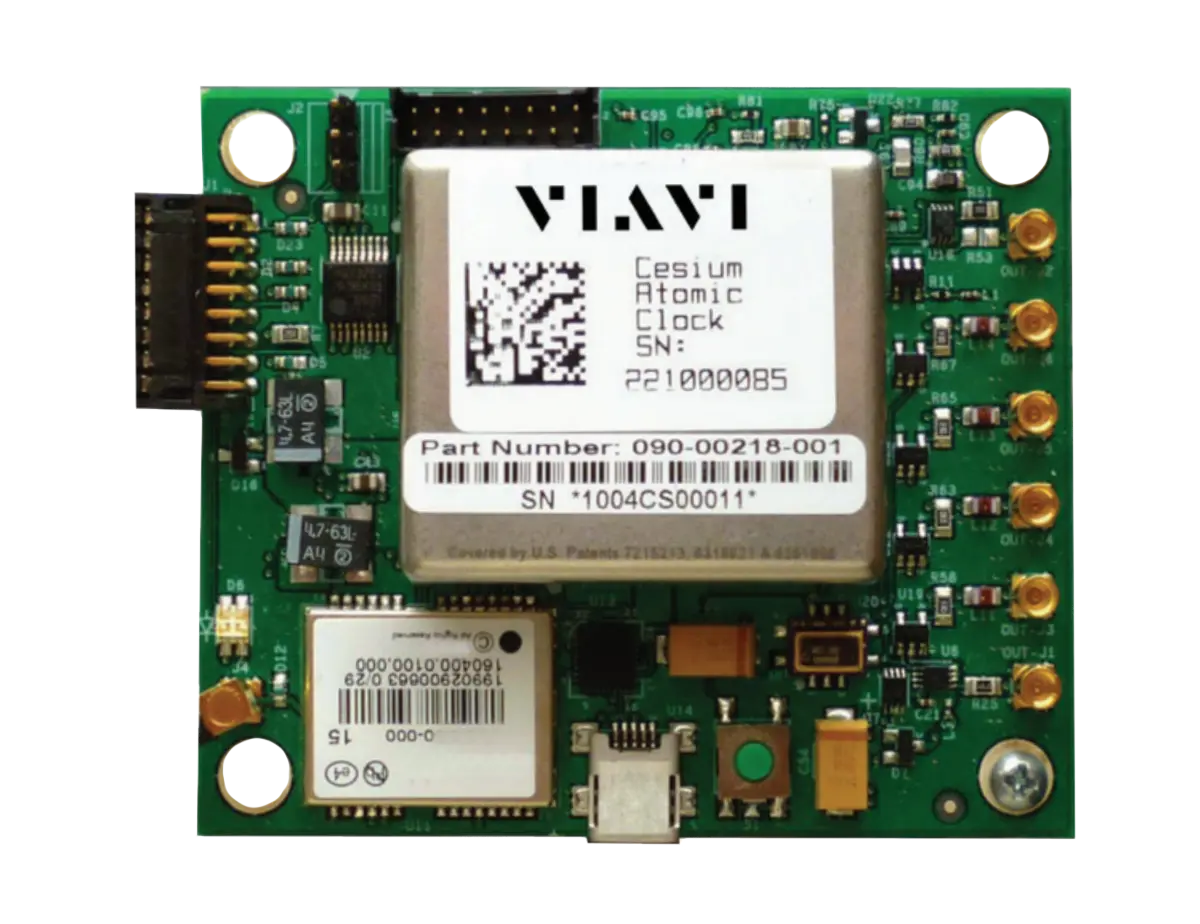
VIAVI CSAC GPSDO Chip Scale Atomic Clock GPS Disciplined Oscillator Frequency Standard
GPS disciplined oscillator module built around a Microsemi SA.45s Chip Scale Atomic Clock for man-pack, airborne and vehicle use.
- Long-Term Oscillator Aging
- Less than 0.3 ppb per month in holdover without GPS; Zero aging with GPS
- Frequency Stability Over Temperature
- Better than ±0.5E-09
- 1 PPS Accuracy
- ±15 ns to UTC RMS (1-Sigma)
- Frequency Accuracy
- Better than ±2E-010
Overview
The VIAVI CSAC GPSDO is a GPS disciplined oscillator module that integrates the Microsemi SA.45s Chip Scale Atomic Clock (CSAC). It is designed for mobile applications such as man-pack, airborne and vehicle installations.
The CSAC technology packages a cesium vapor cell atomic reference oscillator in a unit several orders of magnitude smaller than legacy atomic oscillators, with more than an order of magnitude reduction in power consumption. The technology originates from research sponsored by the U.S. Government.
The module includes a time-interval counter that measures either the 1 PPS signal generated by its internal 50-channel GPS receiver or an externally supplied 1 PPS reference, with a resolution of 20 picoseconds. The CSAC oscillator is phase-locked to either of these 1 PPS signals with typically better than 0.3 ns average phase accuracy, and typically provides better than 5E-12 stability per day in holdover.
Control and software
The GPS receiver supports WAAS, EGNOS and MSAS and drives the CSAC frequency reference under control of a 32-bit processor. The unit is controlled over RS-232 and USB using standard SCPI commands, with settings stored in non-volatile memory. It is compatible with the GPSCon Windows graphing and SNTP server software, and the JLTerm software is also available for download.
Key Features
- Full atomic lock achieved in 110 seconds max. (<60 s typical) after power on
- Phase noise of <125 dBc at >100 Hz offsets using an integrated phase noise filter
- Power consumption of <1.4 W (Sine outputs) and <1 W (CMOS option)
- Less than 0.1 ppb per g per axis typical g-sensitivity
- Better than 1 µs drift per day typical in holdover
- WAAS/EGNOS/MSAS GPS receiver drives a Chip Scale Atomic Clock frequency reference under control of a 32-bit processor
- Holdover mode with aging compensation
- Controlled via RS-232 and USB using standard SCPI commands
- Settings automatically stored in non-volatile memory
- 10 MHz, 5 MHz, and 1 PPS outputs
- Time-interval counter with 20 ps resolution measuring internal GPS or external 1 PPS
- GPSCon Windows graphing and SNTP server software compatible
Specifications
| Long-Term Oscillator Aging | Less than 0.3 ppb per month in holdover without GPS; Zero aging with GPS |
|---|---|
| Frequency Stability Over Temperature |
Better than ±0.5E-09
CSAC only, no GPS Disciplining, 0°C to +70°C
|
| 1 PPS Accuracy |
±15 ns to UTC RMS (1-Sigma)
GPS Locked in Position Hold mode
|
| Frequency Accuracy |
Better than ±2E-010
After 3 minutes operation with GPS lock
|
| Holdover Stability |
<±2 µs over 24 Hour Period @+25°C
After 96 hours warmup; after 20 minutes with GPS lock
|
| Warm Up Time/Stabilization Time Without GPS | <3 min at +25°C to <5E-010 Accuracy Typical |
| 1 s | <1E-10 |
|---|---|
| 10 s | <2.5E-11 |
| 100 s | <2E-11 |
| 1K s | <1E-11 |
| 10K s | <2E-12 |
| 10 Hz | -90 dBc/Hz |
|---|---|
| 100 Hz | -125 dBc/Hz |
| 1 kHz | -145 dBc/Hz |
| 10 kHz | -152 dBc/Hz |
| 100 kHz | -153 dBc/Hz |
| 1 PPS Output (CSAC Flywheel Generated) | 5 V CMOS output, can be shifted in 1 ns steps relative to UTC |
|---|---|
| 10 MHz Output, 5 MHz Output | Four Isolated 10 MHz Sine Wave +13 dBm ±3 dBm, one 5 MHz CMOS 5 V |
| Distribution Amplifier Port Isolation, 2 MHz | >98 dB |
| Distribution Amplifier Port Isolation, 10 MHz | >85 dB |
| TTL Alarm Output | GPS Unlock and Hardware Failure indicator |
| GPS Receiver | 50 Channels, Mobile, SBAS: WAAS, EGNOS, MSAS supported |
|---|---|
| GPS Frequency, Antenna | L1 C/A 1574 MHz, Passive or Active Antenna 5 V, MMCX Connector |
| Sensitivity, Acquisition | -144 dBm |
| Sensitivity, Tracking | -160 dBm |
| GPS TTFF, Cold Start | <45 sec |
| GPS TTFF, Warm Start | 1 sec |
| GPS TTFF, Hot Start | 1 sec |
| GPS Receiver Motion Adaptive Filter Settings | Optimized depending on vehicle velocity (Auto-sensing, Auto-switching) |
| RS-232 Control (Including USB Port) | Full SCPI-99 Control Commands at 9.6 K, 19.2 K, 38.4 K, 57.6 K, 115.2 K |
|---|---|
| RS-232 NMEA Output Sentences | NMEA 0183 rev. 2.3, Sentences: GGA, RMC, ZDA, PASHR, and others |
| USB, LCD support | Optionally USB powered and controlled, supports 16x2 LCD Displays |
| Supply Voltage (Vdd) | Aircraft and Vehicle Power Range: 8 V to 36 V DC, or 5 V via Mini-USB |
|---|---|
| Power Consumption |
<1.4 W
Sine outputs (per product page)
|
|
Power Consumption
CMOS output option
|
<1 W
With CMOS output option (12 V Vdd)
|
| Operating Temperature | -10°C to +70°C |
|---|---|
| Storage Temperature | -45°C to +85°C |
| g-sensitivity |
<0.2 ppb per-g per-axis
Product page states less than 0.1 ppb per g per axis typical; datasheet value shown
|
| Magnetic Sensitivity | Less than 0.4 ppb per Gauss |
| MTBF |
>100,000 Hours
0°C to +70°C
|
| Atomic lock time after power on | 110 seconds max. (<60 s typical) |
|---|---|
| Holdover drift | Better than 1 µs drift per day typical |
| Time-interval counter resolution | 20 picoseconds |
| Average phase accuracy |
better than 0.3 ns
Typical, phase-locked to internal GPS or external 1 PPS
|
| Holdover stability per day |
better than 5E-12
Typical
|
Specifications are taken from the manufacturer's documentation. See the datasheet for complete and current values.
Applications
- Man-pack systems
- Airborne platforms
- Vehicle applications
- Mobile timing and frequency reference
Documents & Resources
Related Products
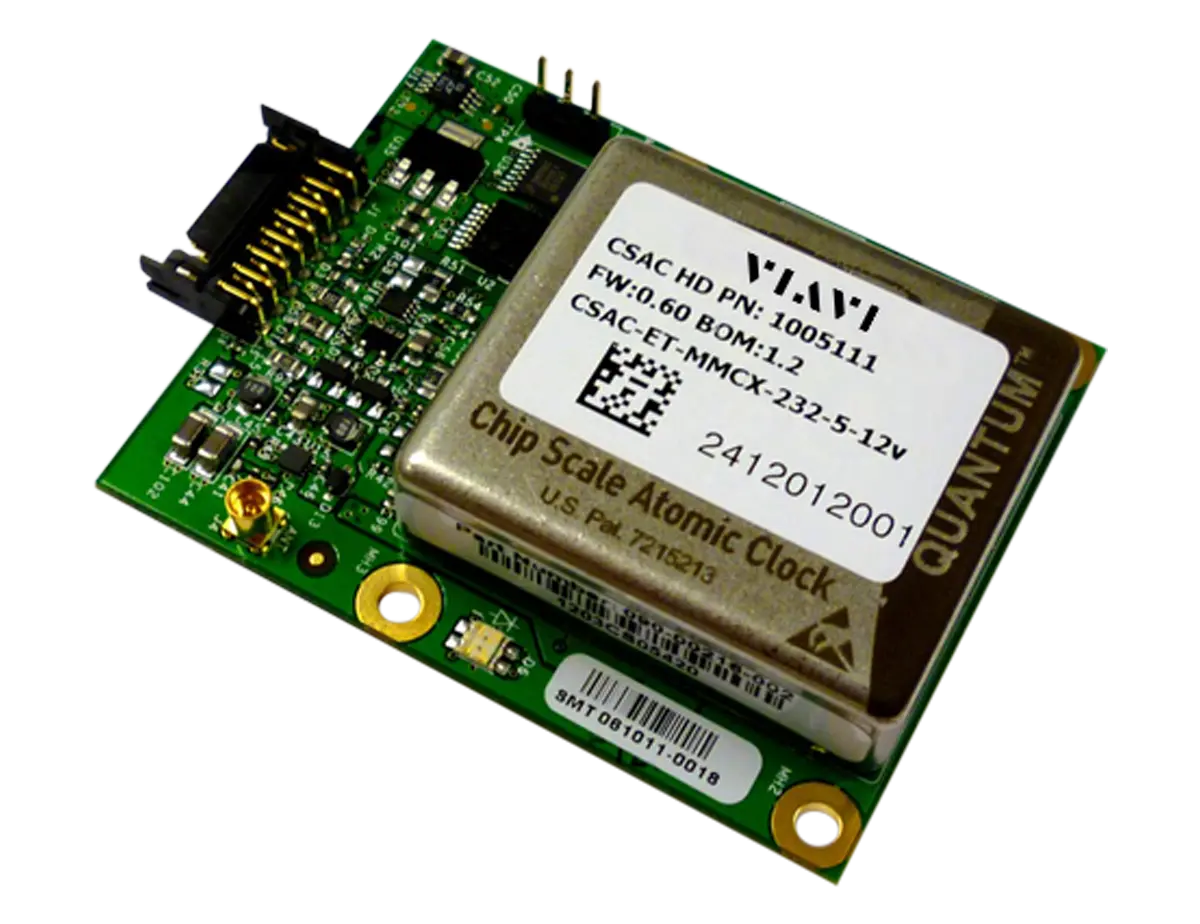
Low-SWaP chip scale atomic clock GPS disciplined oscillator board with 10 MHz and 1 PPS outputs for man-pack, airborne and vehicle use.
Low power 10 MHz CSAC GPS disciplined oscillator module that runs from a single +5 V supply and draws <0.45 W in holdover.
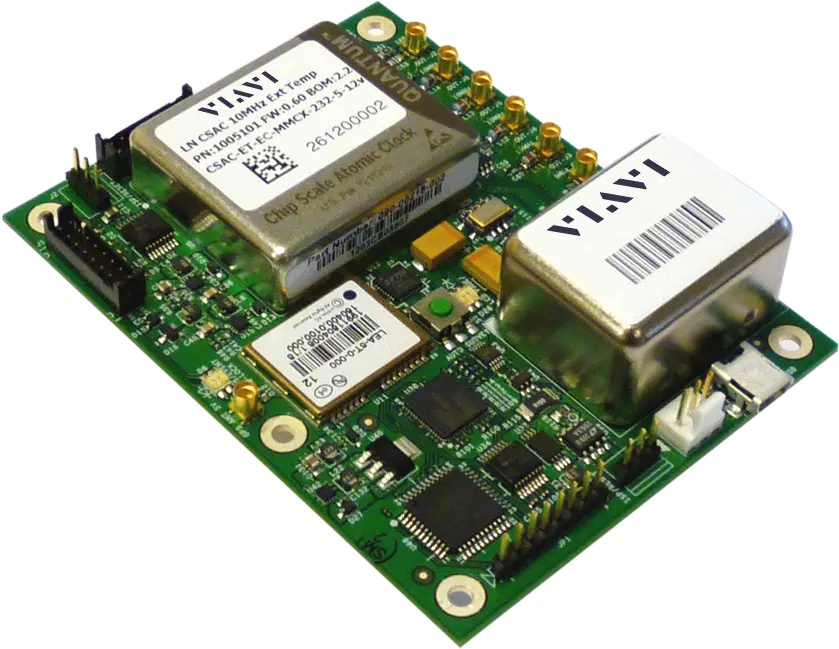
GPS disciplined chip scale atomic clock with an ultra-low noise SC-cut ovenized crystal post-filter and built-in distribution amplifier.