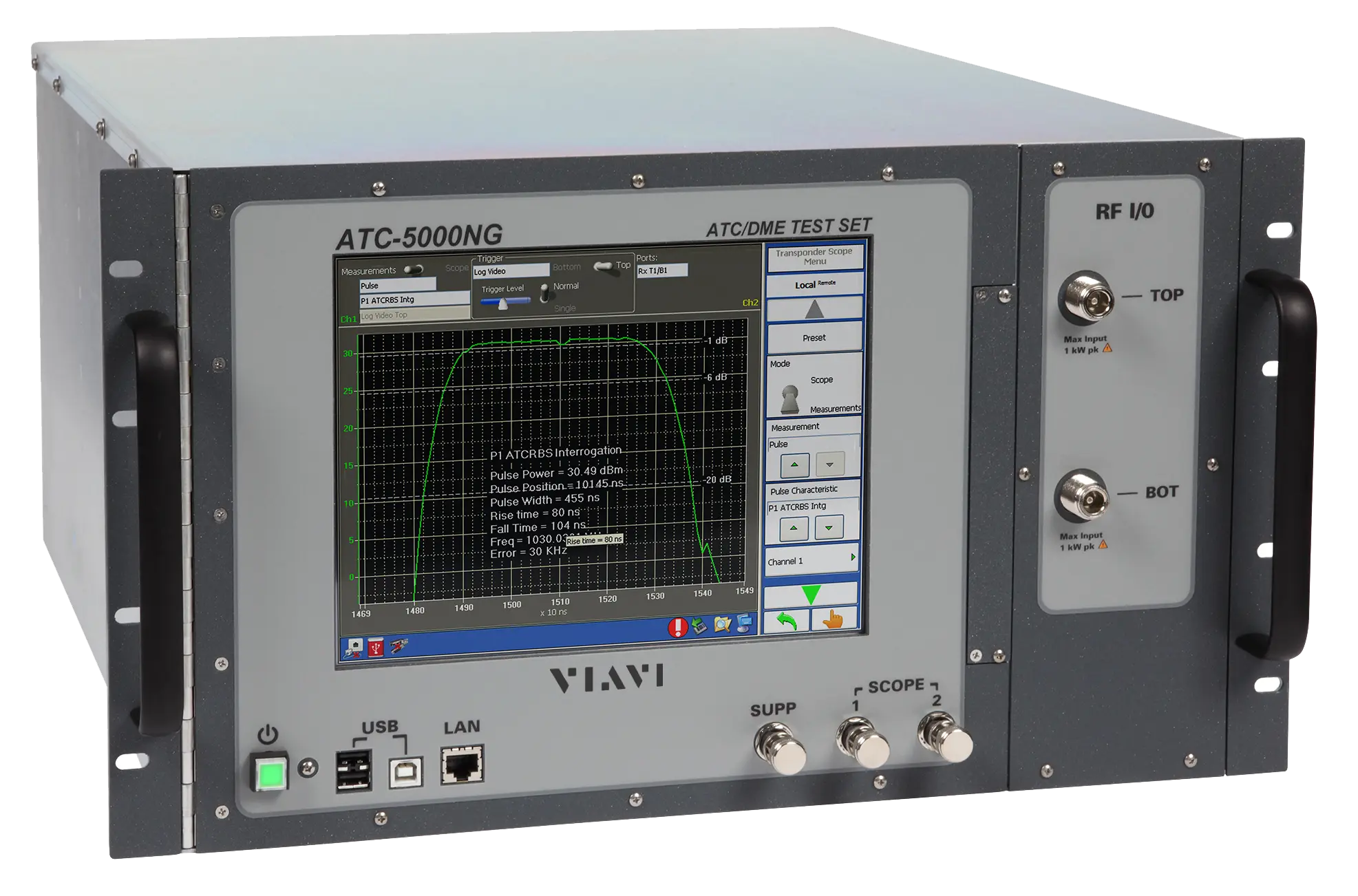
VIAVI ATC-5000NG NextGen Transponder/DME Test Set and ADS-B Target Generator
Software-defined RF test set for Mode A, C and S transponders, DME and ADS-B, with an ADS-B target generator and two independent transmitters and receivers.
- Range
- 952 MHz to 1223 MHz
- Resolution
- 100 kHz
- Accuracy
- 2.5 ppm
- Phase noise
- <-80 dBc/Hz @ 100 kHz
Overview
The VIAVI ATC-5000NG is an RF signal generator and receiver for testing Mode A, C and S transponders. It also serves as a DME test set and an ADS-B target generator, with ADS-B squitter encoding and decoding and data parsing in engineering units.
The test set is built on software-defined radio technology. Its software-driven design allows field updates that add features or capability, or that follow changes in industry requirements. The ATC-5000NG replaces the commercial functionality of the SDX-2000, ATC-1400A and S-1403DL.
It is intended for engineering development, design validation, manufacturing and return-to-service testing. It can run most MOPS tests for DO-181E, DO-260, DO-260A, DO-260B, DO-260C, DO-282B and DO-282C. Options add UAT 978 MHz transmit/receive, multi-receiver testing and canned DO-260B MOPS tests.
The instrument has two independent transmitters and receivers for full diversity testing. It is operated from a 10.4 inch touch screen and can be remote-controlled over GPIB or Ethernet.
Key Features
- Software-driven design allows field updates for new features, capability or modifications due to industry changes
- ADS-B target generator
- ADS-B squitter encode/decode
- DO-260, DO-260A, DO-260B and DO-260C (option) data parsing
- DO-260B canned tests available (option)
- Generates ATCRBS/Mode S interrogations
- Multi-receiver test capability (option)
- UAT TX/RX capability (optional)
- DO-260C new squitter messages available (option)
- DO-282C new message content available (option)
- Pulse and frequency measurement
- 10.4 inch touch screen LCD display for operator control of all test set capabilities
- Remote controlled via GPIB or Ethernet
- Two independent transmitters and receivers
- TX/RX data logging capability
- Full diversity testing capability
- Data parsing in engineering units
Specifications
| Range | 952 MHz to 1223 MHz |
|---|---|
| Resolution | 100 kHz |
| Accuracy | 2.5 ppm |
| Phase noise | <-80 dBc/Hz @ 100 kHz |
| Range (Transponder) | +5 to -110 dBm |
|---|---|
| Resolution (Transponder) | 0.1 dB |
| Accuracy (Transponder) |
±1 dB (+5 to -100 dBm); ±3 dB (< -100 dBm)
@ 1030 MHz
|
|
Range (UAT)
Option 2
|
+5 to -100 dBm
Top antenna port only
|
|
Accuracy (UAT)
Option 2
|
±1 dB @ 978 MHz
Resolution 0.1 dB
|
|
Range (Multi-Receiver)
Option 3
|
-20 to -90 dBm (Low Power Mode); -5 to -65 dBm (High Power Mode); -40 to -110 dBm (Very Low Power Mode)
Resolution 1 dB
|
|
Accuracy (Multi-Receiver)
Option 3
|
±1 dB (+5 to -100 dBm); ±3 dB (< -100 dBm)
@978, 1030 and 1090 MHz
|
| Range (DO-260B) |
-20 to -90 dBm (Low Power Mode); -5 to -65 dBm (High Power Mode); -40 to -110 dBm (Very Low Power Mode)
Resolution 1 dB; accuracy ±1 dB (+5 to -100 dBm), ±3 dB (< -100 dBm) @ 1090 MHz
|
| Range (DME) |
+5 to -110 dBm
Top port only; resolution 0.1 dB; accuracy ±1 dB (-100 to +5 dBm), ±3 dB (< -100 dBm); 952 to 1223 MHz
|
| Harmonics | <-50 dBc |
|---|---|
| Spurious | <-55 dBc, 350 to 1800 MHz |
| Residual FM | 250 Hz Peak |
| DME pulse spectrum at ± 800 kHz offset | <-52 dBc |
| No. of channels | 2 (DME Option); 4 (XPDR/UAT); 6 (ADS-B Option) |
|---|---|
| Diversity power |
±20 dB
Resolution 0.1 dB; accuracy ±1 dB
|
| Diversity timing |
±1 µs
Resolution 25 ns; accuracy ±10 ns
|
| Pulse on/off ratio | >80 dB |
|---|---|
| Mode A interrogation P1-P3 default |
8.0 µs
Accuracy ±10 ns; high speed rise/fall time mode
|
| Mode C interrogation P1-P3 default |
21.0 µs
Accuracy ±10 ns
|
| ATCRBS interrogation variation |
±1.95 µs
Resolution 25 ns; accuracy ±10 ns (P1-P3), ±15 ns (P1-P2 and P3-P4)
|
| Mode S interrogation P1-P2 default |
2.0 µs
Accuracy ±10 ns
|
| Mode S interrogation P6 to SPR default |
1.25 µs
Accuracy ±15 ns
|
| Interference interrogation signal #1 (relative to P1 pulse) |
-17.5 to 400 µs
Resolution 25 ns; accuracy ±20 ns
|
| DME P1 to P2 default |
12 or 30 µs
Accuracy ±50 ns
|
| DME P1 to P2 variation |
DME X +7.9 µs to -2.5 µs; DME Y +7.9 µs to -7.9 µs
Resolution 25 ns; accuracy ±50 ns
|
| ATCRBS interrogation P1/P2/P3 default |
0.8 µs
Accuracy ±10 ns
|
|---|---|
| Mode S interrogation P6 short / long default |
16.25 µs / 30.25 µs
Accuracy ±10 ns
|
| Interference pulse width |
0.2 to 32.0 µs
Resolution 25 ns; accuracy ±25 ns
|
| DME P1/P2 width variation |
3.5 to 9.0 µs
Default 3.5 µs; resolution 25 ns; accuracy ±250 ns
|
| Pulse rise/fall time (transponder) |
<50 / <50 ns
Accuracy <50 ns
|
| Pulse rise/fall time (DME) |
2.0 / 2.5 µs
Accuracy ±25 µs
|
| ATCRBS interrogation amplitude variation (all pulses) |
+9 to -19 dB
Resolution 0.1 dB; accuracy ±0.5 dB
|
| DME echo amplitude |
+6 to -15 dB
Resolution 0.1 dB; accuracy ±0.5 dB
|
| Interrogation table unique messages | 1 to 1000 |
|---|---|
| Interrogations/burst | 1 to 10K |
| Burst spacing |
0 to 20 s
0 s for single burst transmissions; resolution 0.1 s; accuracy ±100 ms
|
| Block transmissions unique messages | 1 to 2000 messages |
| No. of blocks | 1 to 50,000 or infinite |
| Block period |
10 ms to 90 seconds
Resolution 1 ms; accuracy ±1 ms
|
| PRF (single interrogation) |
1 to 10,000 Hz
Resolution 1 Hz; accuracy 0.1% of setting
|
| Interlace ratio | 1:1 to 1:1000 |
| Suppressor pulse amplitude | >25 V (fixed) |
| Ident frequency |
1350 Hz
Accuracy ±0.02%
|
|---|---|
| Dot variation |
50 to 250 ms
Default 120 ms; resolution 10 ms; accuracy ±1 ms
|
| Dash variation |
150 to 750 ms
Default 360 ms; resolution 10 ms; accuracy ±1 ms
|
| Range |
-1 to 400 nmi
Resolution 0.01 nmi; accuracy ±0.02 nmi
|
| Velocity |
0 to 10000 knots
Resolution 1 knot; accuracy ±0.001% of setting
|
| Squitter |
0 to 8000 Hz
Resolution 1 Hz; accuracy 10 Hz or 2%, whichever is greater
|
| Reply efficiency |
0 to 100 %
Resolution 1%; accuracy ±0.5%
|
| VSWR | <1.4 (952 to 1223 MHz) |
|---|---|
| Max input power | +60 dBm |
| Operating range (XPDR) | +17 to +60 dBm (1090 ±3 MHz) |
|
Operating range (UAT)
Option 2
|
+30 to +57 dBm (978 ±3 MHz)
Bottom antenna port only
|
| Operating range (DME) | +17 to +60 dBm (1020 to 1155 ±3 MHz) |
| Decoded messages | ATCRBS Interrogation and Replies; Mode S Interrogations and Replies; UAT Ground and Airborne Messages [UAT Option]; DME Interrogations |
| No. of channels | 2, Top/Bottom |
| Power |
+17 to +60 dBm
XPDR 1090 ±3 MHz, DME 1025 to 1150 MHz; resolution 0.1 dB; accuracy ±0.5 dB
|
|---|---|
| Frequency (XPDR) |
1090 MHz +3 MHz
Resolution 1 kHz; accuracy ±50 kHz
|
| Frequency (DME) |
RX Channels (1025 to 1150 MHz ±1 MHz)
Resolution 1 kHz; accuracy ±20 kHz
|
| Pulse spacing accuracy |
±10 ns (XPDR); ±50 ns (DME)
Resolution 1 ns
|
| Pulse width accuracy |
±15 ns (XPDR); ±50 ns (DME)
Resolution 1 ns
|
| Pulse rise/fall time accuracy |
±15 ns (XPDR); ±100 ns (DME)
Resolution 1 ns
|
| Reply delay (XPDR: ATCRBS & Mode S) accuracy |
±50 ns
Resolution 25 ns
|
| Reply jitter accuracy |
±20 ns
Resolution 1 ns
|
| Percent reply |
0 to 100%
Sample size equal to PRF or 200, whichever is greater; resolution 0.1 %; accuracy ±1 %
|
| Interrogation rate (DME) |
0 to 10 kHz
Resolution 1 Hz; accuracy ±1 Hz
|
| DF11 |
0.01 s to 4.0 s
Resolution 1 ms; accuracy ±1 ms ±2.5 ppm
|
|---|---|
| DF17 airborne position |
0.01 s to 2.0 s
Resolution 1 ms; accuracy ±1 ms ±2.5 ppm
|
| DF17 surface position |
0.01 s to 15.0 s
Resolution 1 ms; accuracy ±1 ms ±2.5 ppm
|
| DF17 A/C identification |
0.01 s to 25.0 s
Resolution 1 ms; accuracy ±1 ms ±2.5 ppm
|
| DF17 airborne velocity |
0.01 s to 2.0 s
Resolution 1 ms; accuracy ±1 ms ±2.5 ppm
|
| DF17 event driven |
0.01 s to 25.0 s
Resolution 1 ms; accuracy ±1 ms ±2.5 ppm
|
| Width (XPDR, DME) |
1.0 µs
Scope 1 and Scope 2; accuracy ±0.5 µs
|
|---|---|
| XPDR interrogation position |
-1.0 to +600 µs relative to rising edge of P1 (default -1.0 µs)
Resolution 25 ns; accuracy ±0.5 µs typical
|
| Full specified performance temperature |
23°C, ±5°C (73.4°F, ±41°F)
Requires 45 minute warm-up period to meet specified performance
|
|---|---|
| Operating temperature | 0 to +40°C (32° to 104°F) |
| Storage temperature | 0 to +71°C (32° to 159.8°F) |
| Relative humidity | 0 to 95% noncondensing |
| Degree of protection | IPX-0 |
| Voltage range | 100 to 240 VAC, 50 to 60 Hz |
|---|---|
| Power consumption | 100 W nominal |
| Dimensions | 10.5 in (H) x 19 in (W) x 24 in (D) (26.7 cm x 48.3 cm x 60.9 cm) |
|---|---|
| Weight |
41 lbs (18.6 kg)
Test set only
|
| Display | 10.4 inch touch screen LCD |
| Remote interface | Ethernet, GPIB |
|---|---|
| Inputs/outputs | Suppression bus (front/back); 2 scope BNC outputs (front/back); LAN (front/back); 2 USB Type A (front) for HID/flash drives |
| Test set certifications | MIL-PRF-28800F (Class 3 Device), CE, UL/EN 61010-1, EN 61326-1 |
|---|
Specifications are taken from the manufacturer's documentation. See the datasheet for complete and current values.
Applications
- Engineering development
- Certification
- Manufacturing
- Service and return-to-service testing
- MOPS testing for DO-181E, DO-260, DO-260A, DO-260B, DO-260C, DO-282B and DO-282C
- Mode S/ADS-B Out transponders
- ADS-B In receivers
- UAT transceivers
- 1090MHz DF18 emitters (surface vehicles)
- ADS-B In ground station receivers
- ADS-R and TIS-B ground station transmitters
- DMEs
Options & Accessories
| Option | Description |
|---|---|
| Option 2 | UAT 978 MHz — UAT TX/RX capability |
| Option 3 | Multi-Receiver — Multi-receiver test capability |
| Option 6 | DO-260B MOPS Test — DO-260B canned tests |