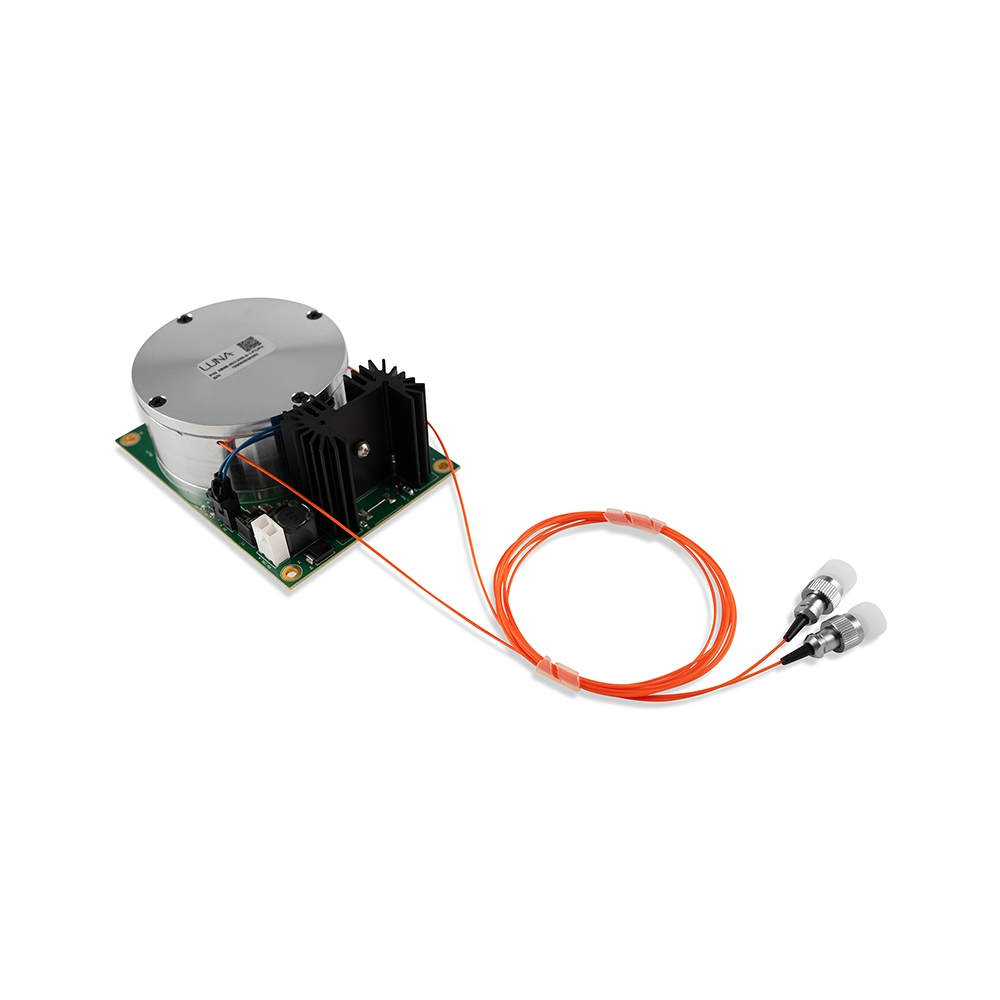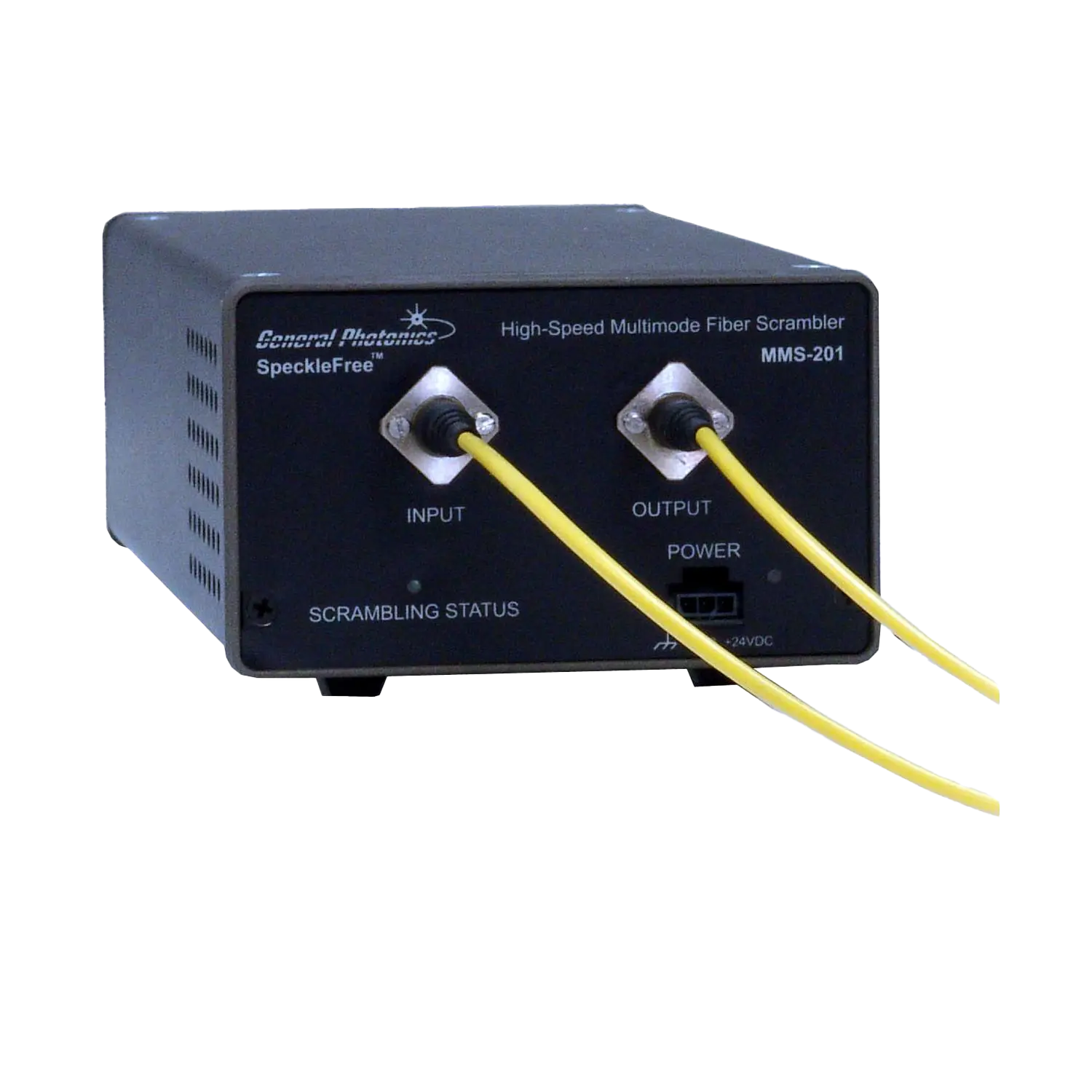
SpeckleFree MMS-201 Multimode Scrambler for Multimode Fiber Speckle Reduction
All-fiber multimode scrambler that randomizes laser speckle patterns at 150 kHz for uniform time-averaged core illumination.
- Wavelength range
- 530-1630nm
- Scrambling efficiency
- >80% (effective power)
- Flatness
- <20% typical
- Ripple
- <10% typical
Overview
The MMS-201 Multimode Scrambler, part of the General Photonics SpeckleFree line now offered by Luna, randomizes laser speckle patterns in multimode fiber so that the time-averaged core illumination is more uniform. The product has been discontinued; the Miniature Multimode Scrambler (MMS-003) is the listed replacement.
Speckle patterns from a multimode fiber can cause problems in applications that require uniform, stable light distributions at the fiber output. The MMS-201 randomizes multimode speckle patterns over time at a frequency of about 150 kHz, so the output light distribution appears uniform and stationary to cameras or detectors with averaging times greater than 80 ms. Its all-fiber optical path keeps insertion loss low, and the internal fiber gets a special surface treatment to prevent breakage under stress.
Operation
The module runs on a +24 V DC supply through a 3-pin front-panel connector. Scrambling starts as soon as power is applied. A rear-panel BNC input accepts a TTL signal to enable or disable scrambling without removing power, and front-panel LEDs show power and scrambling status. Input and output fiber pigtails are on the front panel. Four corner mounting holes on the bottom take 6-32 screws.
Key Features
- High speed
- High efficiency
- Low insertion loss
- Compact
- Reliable
- All-fiber optical path
- Scrambling frequency over 150 kHz
- TTL enable/disable control via rear-panel BNC input
- Power and scrambling status indicator LEDs
- Can be made with custom fiber
Specifications
| Wavelength range | 530-1630nm |
|---|---|
| Scrambling efficiency |
>80% (effective power)
Measured over 80 ms integration time at 635 nm; defined as (light energy ≥ 80% of maximum intensity/total energy)*(area over which intensity is ≥ 80% of maximum intensity/total core area)
|
| Flatness |
<20% typical
Measured over 80 ms at 635 nm; (max - min intensity) as % of max intensity over the center 80% of the fiber core area
|
| Ripple |
<10% typical
Measured over 80 ms at 635 nm; max peak-to-valley intensity fluctuation as % of max intensity within the center 80% of the fiber core area
|
| Scrambling frequency | 150±5 kHz |
| Insertion loss |
≤1 dB at 635nm, including connectors
User guide gives maximum insertion loss at 635nm as 1.0 dB including connectors
|
|
Return loss
PC connector
|
>50 dB (with PC connector) |
|
Return loss
APC connector
|
>55 dB (with APC connector) |
| Optical power handling | 400 mW |
| Fiber type | 50/125µm step index MM fiber |
|---|---|
| Fiber core diameter | 50 µm (step index) |
| Fiber NA |
0.2
Page and datasheet state 0.2; user guide states 0.22
|
| Connector type | FC/APC or FC/PC |
| Pigtail length |
1 m each side
3mm protective jacketing
|
| Power supply | +24VDC/1.5A |
|---|---|
| Power supply voltage | 24±2V |
| Current consumption | 0.75A typical, 1A maximum |
| Drive voltage | 50-65 V peak-to-peak |
| Enable/disable signal |
TTL high = enabled, TTL low = disabled
Rear-panel BNC input; open/no input = enabled
|
| Power connector |
Molex 0436450300 3 Position Rectangular Housing Connector Receptacle
Mating connector Molex 0436400301
|
| Operating temperature | 10 to 40°C |
|---|---|
| Storage temperature | −20 to 70°C |
| Operating humidity | 20 to 80% RH (non-condensing) |
| Operating pressure | Atmospheric |
| Dimensions | 23 (L) x 10.5 (W) x 6.5 (H) cm |
| Weight | 1.1 kg |
Specifications are taken from the manufacturer's documentation. See the datasheet for complete and current values.
Applications
- DNA sequencing
- Multimode fiber sensing
- Test and measurement of multimode fiber devices
- MM to SM coupling
- Free-space optical communication
- OEM modules for fiber optic sensing
Included
- MMS-201 Multimode Scrambler
- Electrical connection cable
- User guide