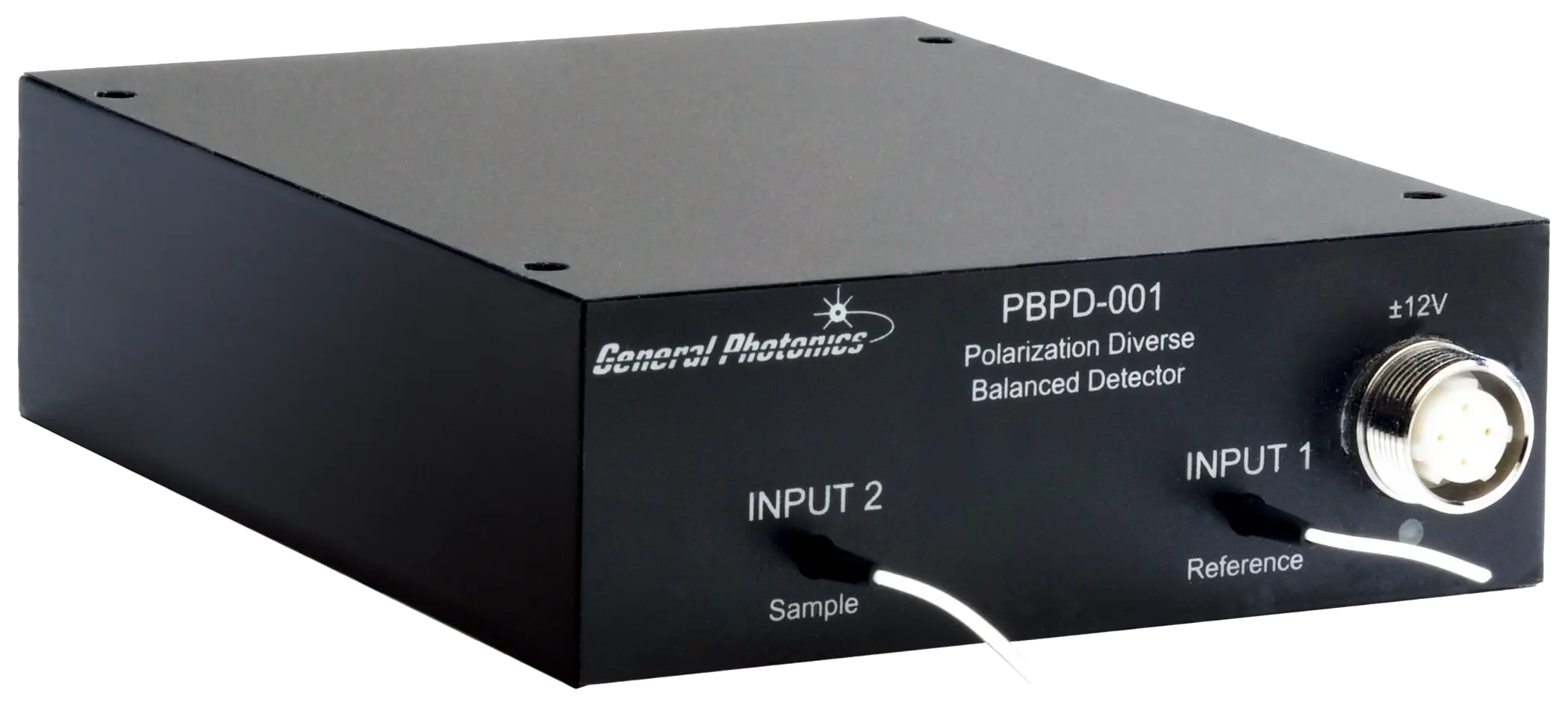
PBPD-001 Polarization Diverse Balanced Photodetector
Polarization diverse balanced photodetector that analyzes the two polarization components of an input optical signal separately.
- Wavelength range
- 1310±50nm
- Polarization crosstalk
- <25 dB
- PDL (before polarization splitting)
- <0.25 dB
Overview
The Luna PBPD-001 Polarization Diverse Balanced Detector performs separate analysis of the two polarization components of an input signal. It is intended for polarization-sensitive measurements that require a high signal-to-noise ratio.
The device is fully enclosed in an aluminum box. It has two optical input ports and a power supply port. For each polarization component, it provides a set of output ports: a balanced RF output and two monitor outputs.
The PBPD-001 is suitable for integration into polarization-sensitive optical coherence tomography (OCT), fiber sensor and optical measurement systems. The manufacturer lists this product as discontinued.
Key Features
- Analysis of both polarization components
- Low noise
- High CMRR
- High conversion gain
- Compact
Specifications
| Wavelength range |
1310±50nm
standard
|
|---|---|
| Polarization crosstalk |
<25 dB
splitting element
|
| PDL (before polarization splitting) | <0.25 dB |
| Transimpedance gain |
3 × 10⁴ V/A
As printed on the manufacturer page; exponent formatting likely lost (3 × 10^4)
|
|---|---|
| Conversion gain |
> 30 V / mW
interference signal
|
| RF bandwidth (3 dB) | DC-210 MHz |
| CW balanced saturation power | 150 μW |
| NEP (DC-100 MHz) | <11 pW/√Hz |
| CMRR | >25 dB |
| Monitor bandwidth | 1 MHz |
|---|---|
| Monitor conversion gain | 2 V/mW |
Specifications are taken from the manufacturer's documentation. See the datasheet for complete and current values.
Applications
- Optical coherence tomography
- OEM modules for fiber optic sensing
- Polarization-sensitive OCT systems
- Fiber sensor systems
- Optical measurement systems